
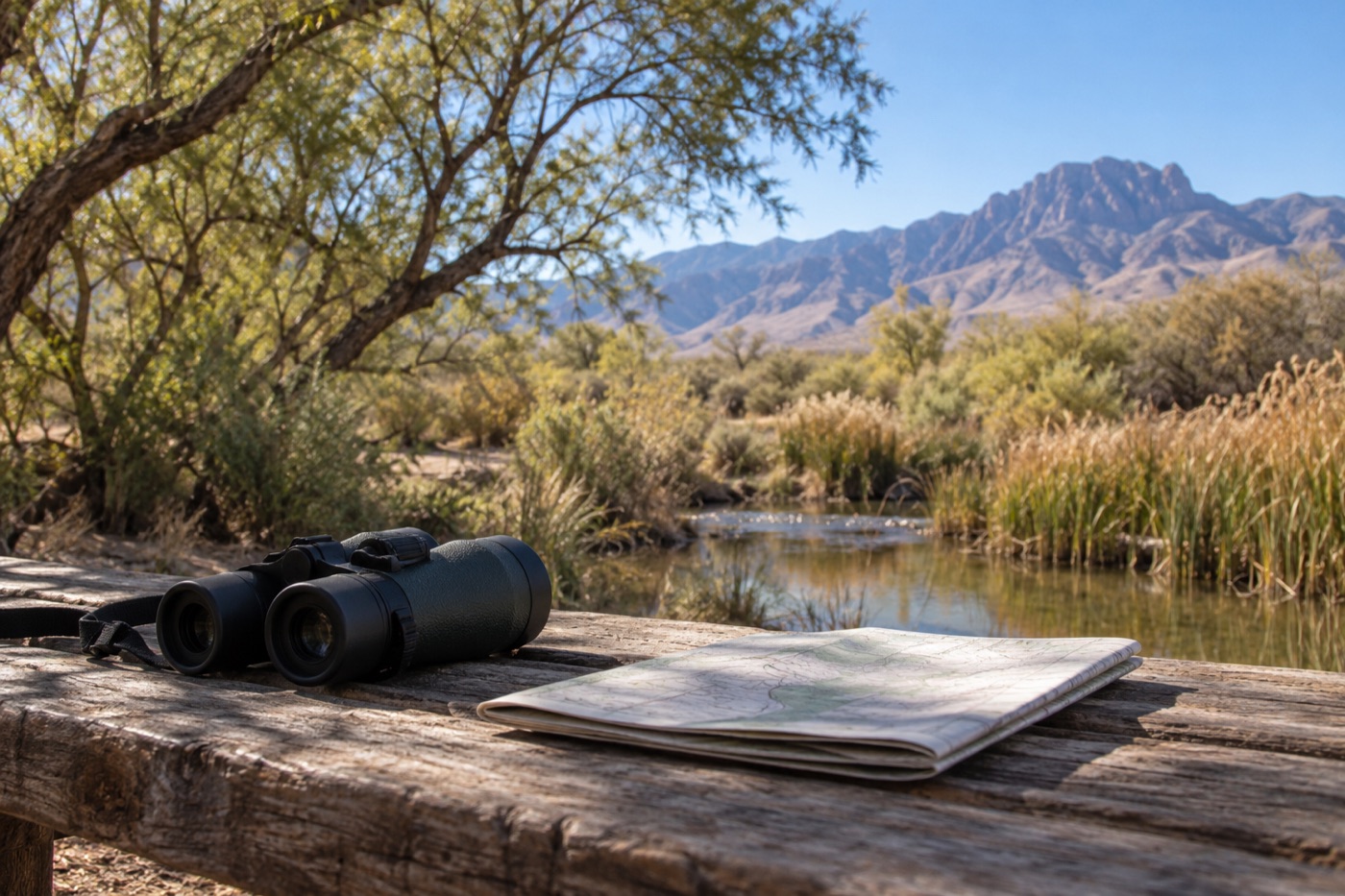
Corn Creek is a good Las Vegas nature outing when you want a short walk, birds, and a little time around desert water without committing to a mountain hike. Start at the Corn Creek Visitor Center in Desert National Wildlife Refuge, explore a nearby loop, and leave the refuge’s long backcountry roads for a separate, properly prepared trip.
The appeal is small-scale: a pause beside the pond, movement in the trees, and an exhibit that helps explain the desert outside. For a first visit, I would allow about an hour to 90 minutes, including the visitor center if it is open. That is a suggested pace, not a scheduled tour.
Before you go: the October trail reopening
The refuge’s October 22, 2026 reopening notice lists Bighorn, Coyote, and Birdsong loops as open following the October 11 flooding. It also warns that conditions remain rough. Check the latest notice and follow signs when you arrive; a reopened route does not promise a smooth surface.
Keep this outing around Corn Creek. Backcountry road conditions are a separate question, and the refuge warns of rough roads and uncertain conditions farther out. A visitor-center morning does not need an extra desert drive.
Getting to Corn Creek, not the refuge office
Use 16001 Corn Creek Road, Las Vegas, NV 89124 as your destination. The refuge complex also has an administrative office on North Torrey Pines Drive. That is not the Corn Creek Visitor Center.
The official visitor directions approach from US-95 and follow Corn Creek Road for four paved miles to the visitor center. Use those directions rather than choosing a remote entrance simply because a map labels it Desert National Wildlife Refuge. The refuge cautions that its other entrances do not always connect to the visitor center.
- Visitor center: FWS lists Thursday through Monday, 8 a.m. to 4 p.m. Confirm before a trip built around indoor exhibits; staffing and seasonal schedules can affect opening.
- Corn Creek trails: listed for sunrise to sunset, subject to closures.
- Refuge phone: 702-879-6110.
Arrive with your water, sun protection, and a saved map. Cell reception is limited in the refuge. A little preparation lets you put the phone away and enjoy the walk.
Start with the visitor center, then choose a loop
Inside the visitor center, wildlife and human-history exhibits give the outing some context. FWS also lists maps, brochures, and a 17-minute orientation film. If the building is open, ask which trail best matches your group and the day’s surface conditions.
The Corn Creek trail network totals approximately 1.5 miles. You do not need to walk all of it. The official trail descriptions make three useful first-visit choices:
Coyote Loop for the pond and small discoveries
FWS lists Coyote Loop at 0.35 mile. Its route takes in the pond and stream, the old orchard, and a refugium that houses endangered Pahrump poolfish. A spur leads toward the historic railroad-tie cabin.
This would be my starting choice for a group that likes stopping to look. Give everyone time at the water instead of treating the loop as a distance to finish. The fish habitat and cabin are places to look and learn, not promises of a staffed demonstration or an open interior.
Bighorn Loop for open desert views
Also listed at 0.35 mile, Bighorn Loop moves into more open desert with views toward the Sheep Range. Choose it for the contrast between the spring-side vegetation and the surrounding desert.
The name is not a wildlife guarantee. Enjoy the mountains and any animals you happen to see without making a bighorn sighting the measure of a successful visit.
Birdsong Loop for a quieter birdwatching walk
Birdsong Loop is listed at 0.38 mile and described as single track through mesquite and more open terrain. It is worth considering if your group enjoys listening and waiting. Check the current footing before adding it, especially after the recent flooding.
For wheels or limited mobility, ask staff about a suitable route rather than assuming every short loop has the same surface. The refuge lists accessible trail options, but current conditions matter more than a general trail label.
A simple plan with children or a first-time visitor
Start indoors if the center is open, then choose one outdoor loop. A pair of binoculars gives older children something to try; younger children can look for a bird in a tree, a reflection, or a change in the plants beside the water. There is plenty to notice without a checklist of animals you must find.
The National Park Service’s Corn Creek listing identifies restrooms, a water refill station, picnic tables, and parking. It also lists Corn Creek as a place to obtain Tule Springs Fossil Beds information and Junior Ranger materials. Ask about availability while the visitor center is open, and bring drinking water rather than relying on a refill.
Let the first loop be the outing if everyone is happy. For a park-centered alternative, our Floyd Lamb Park guide helps you plan a different northwest-side outdoor day. There is no need to fit both into one morning.
Keep the water and wildlife safe
Corn Creek’s water belongs to the habitat. The refuge’s visitor rules prohibit swimming, wading, washing, and fishing in refuge waters. Enjoy the pond from the path and leave plants, historic objects, and natural features where they are.
Keep pets leashed and clean up after them. Carry out food scraps and other rubbish. Drones are prohibited, so bring binoculars or a handheld camera for a quiet wildlife outing instead.
Choose comfortable weather for walking, stay alert to changing conditions, and leave flooded routes alone. Even a short desert walk deserves water and sun protection.
Is Corn Creek worth the trip?
Yes, for a modest nature outing with time to look closely. It suits a curious child, a birdwatcher, or two adults who want a quiet walk and conversation. I would choose another plan for a playground afternoon, a swimming stop, or a long scenic drive in an ordinary car.
Our outdoor Las Vegas guide has other ways to spend time outside. If Corn Creek introduces you to the area’s protected landscapes, the national parks near Las Vegas guide explains the differences between nearby stops and larger road trips. Corn Creek itself is part of a national wildlife refuge, not a national park.
Corn Creek questions
Can you walk the trails when the visitor center is closed?
The posted schedules are separate: Corn Creek trails are listed for sunrise to sunset, while the visitor center has a Thursday-through-Monday schedule. Temporary closures and onsite signs still apply. Do not plan on indoor exhibits outside the building’s opening hours.
Do you need four-wheel drive?
The official approach from US-95 to the visitor center follows paved Corn Creek Road. That is different from the refuge’s backcountry routes, where high clearance and four-wheel drive can be necessary. Stay with the visitor-center approach for this outing and check alerts before leaving.
Is this a place to swim or feed birds?
No. The refuge prohibits entering its waters for swimming or wading, and food waste can harm wildlife. Watch from the trail, keep your snacks for people, and take leftovers home.