
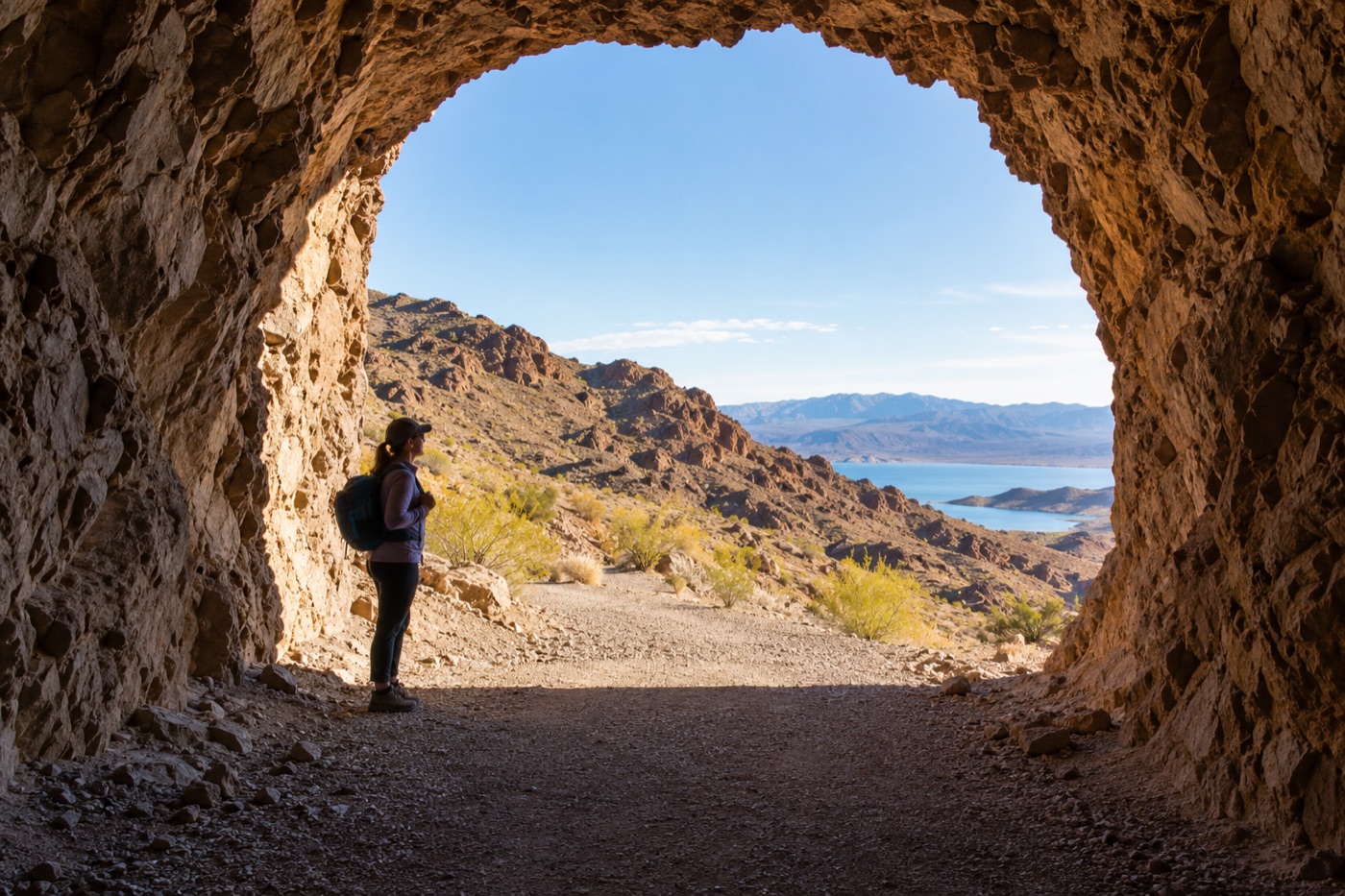
The Historic Railroad Trail near Boulder City is a good cool-weather outing for lake views, old railroad tunnels and a walk you can shorten to suit your group. Start from the trailhead below the Lake Mead Visitor Center, carry your water, and choose your turnaround before you set off. You do not need to walk all the way to Hoover Dam to enjoy it.
My pick for a first visit is a tunnel-focused out-and-back, with the return walk treated as part of the plan. The full route is a much longer commitment than the word “easy” suggests. It is also an exposed desert trail, not a shaded lakeside promenade.
Start at the Lake Mead end
The National Park Service trail page places the trailhead parking lot below the Lake Mead Visitor Center on Lakeshore Road. Use that trailhead for this plan, rather than navigating to Hoover Dam’s parking garage.
The Lake Mead Visitor Center is at 10 Lakeshore Road, Boulder City. Its address is a useful arrival reference, but the visitor center and the trailhead lot are not the same parking stop. NPS lists pit toilets at the trailhead and drinking water at the nearby visitor center. Fill bottles before starting instead of depending on water farther along the route.
Before leaving home, check Lake Mead alerts and conditions for trail notices and weather. Follow any posted barriers at the tunnels. An older trip report is not a reliable guide to today’s access.
How far is the Historic Railroad Trail?
NPS lists the full route as 3.7 miles one way and 7.5 miles round trip. That is the full-trail figure, not a promise that every visitor will want to cover it.
For a first outing, decide how much walking time your group wants and leave equal room for the return. A short walk toward the tunnels and a full walk toward the dam are different plans. Choose the shorter version freely; the scenery and railroad history do not require a finish-line photo.
If reaching a particular tunnel is important, review the current route map before setting a distance goal. Do not assume the first tunnel is next to the parking lot. NPS warns that the first 1.5 miles have no shade.
Five tunnels, lake views and real construction history
The route follows a former railroad bed used to haul materials for Hoover Dam construction. The tracks are gone. The NPS railroad history page describes five tunnels and views of Lake Mead and Boulder Basin.
That gives the walk a clear purpose for someone who likes engineering or local history: look at the tunnel cuts, read the interpretation along the way and picture materials moving through this landscape. It is a walking and cycling route, not a train ride.
For an actual excursion train, see our separate Nevada State Railroad Museum guide. The museum outing and the tunnel trail have different starting points and should not be confused.
Is it suitable for children, strollers or wheelchairs?
The trail’s broad railroad-bed sections make it appealing for a group that wants less climbing. NPS describes a level, hardpacked fine-gravel surface and says bikes and wheelchairs can navigate it. It also notes protective shipping containers in two tunnels, with short ramps at their ends.
That is useful information, but it is not a guarantee that every chair, stroller or visitor can comfortably complete the entire route. Gravel, ramps, current surface conditions and the distance back to the car all matter. Ask the visitor center about the specific section you intend to use if access is central to your plan.
For children, choose a manageable walking goal and pause where the group can stand clear of passing trail users. Keep everyone together through the tunnels and on the established path. A cooler morning with time to look around is a better first introduction than a long route on a warm afternoon.
For other short-route choices, compare our easy hikes near Las Vegas.
Plan around sun, not just the calendar
NPS recommends fall, winter and spring for this outing and does not recommend the trail in summer. The tunnels provide intermittent shelter, but they do not shade the approach.
Bring drinking water for the whole walk, sun protection and shoes suited to gravel. Check the forecast for heat, wind and storms before heading out. A cool season is a useful starting point, not a substitute for that day’s conditions.
Dogs are allowed under the NPS trail rules, on a leash no longer than six feet. Bring water for them too, clean up after them and consider ground temperature before choosing this outing.
Do you need a park pass?
Do not plan this as an automatically free hike. The NPS hiking page identifies the Historic Railroad Trail as being in a fee area and tells visitors to keep a park pass or proof of admission with their vehicle for inspection.
Check the current Lake Mead fees and passes for the pass that covers your visit. The park is cashless, and its fee page says entrance passes are not sold at the Alan Bible Visitor Center. Sort out the applicable pass before starting the walk.
Pair it with Boulder City, or make Hoover Dam a separate stop
A shorter trail outing followed by time in Boulder City is my preferred relaxed version. You can enjoy the tunnels without committing the whole group to a long walk to the dam.
If Hoover Dam is the main reason for the trip, use our Hoover Dam planning guide for that visit. A trail connection does not include a dam tour or museum admission. Plan any separate dam stop around its own access and ticket rules rather than assuming the hike covers everything.
Quick questions
Is this a loop?
The first-visit plan here is an out-and-back from the Lake Mead end. Turn around at your chosen point and return to the same trailhead. Do not assume transport will be waiting at the other end.
Is it a good summer hike?
It is not my summer recommendation. NPS advises against summer hiking here, and the first 1.5 miles are unshaded. Save it for cooler conditions.
Can you walk through all five tunnels?
Five historic tunnels are part of the route. Check current NPS alerts and obey on-site closures before making all five your goal; this guide does not guarantee every tunnel is accessible on your visit date.
Do you have to reach Hoover Dam?
No. A shorter return walk is a worthwhile outing on its own. Pick the distance that suits your group, with enough water and energy for the walk back.